
Fault Finder
A daily no-guess fault hunt: clear the healthy nodes, flag the faults, never guess.
Loading your friend’s challenge…
Fault Finder
Today's cluster is on its way.
Today's cluster
Lives ♥♥♥
Time 0:00
- Closed node: healthy or faulty, unknown
- 2 Cleared node: its faulty neighbours
- Flag: marked faulty
- 0 Locked starter: cleared from the start
Tap a node to clear it; long-press, right-click or F flags it. Keys: arrows move, Space clears, F flags, U undo.
Tap a closed node to clear it; long-press to flag a fault.
Isolate the faults to file your time.
Next scan at midnight UTC.
How everyone did today appears here once 20 players have finished.
0Solved
0Spotless
0Streak
0Best streak
–Best 8×8
–Best 10×10
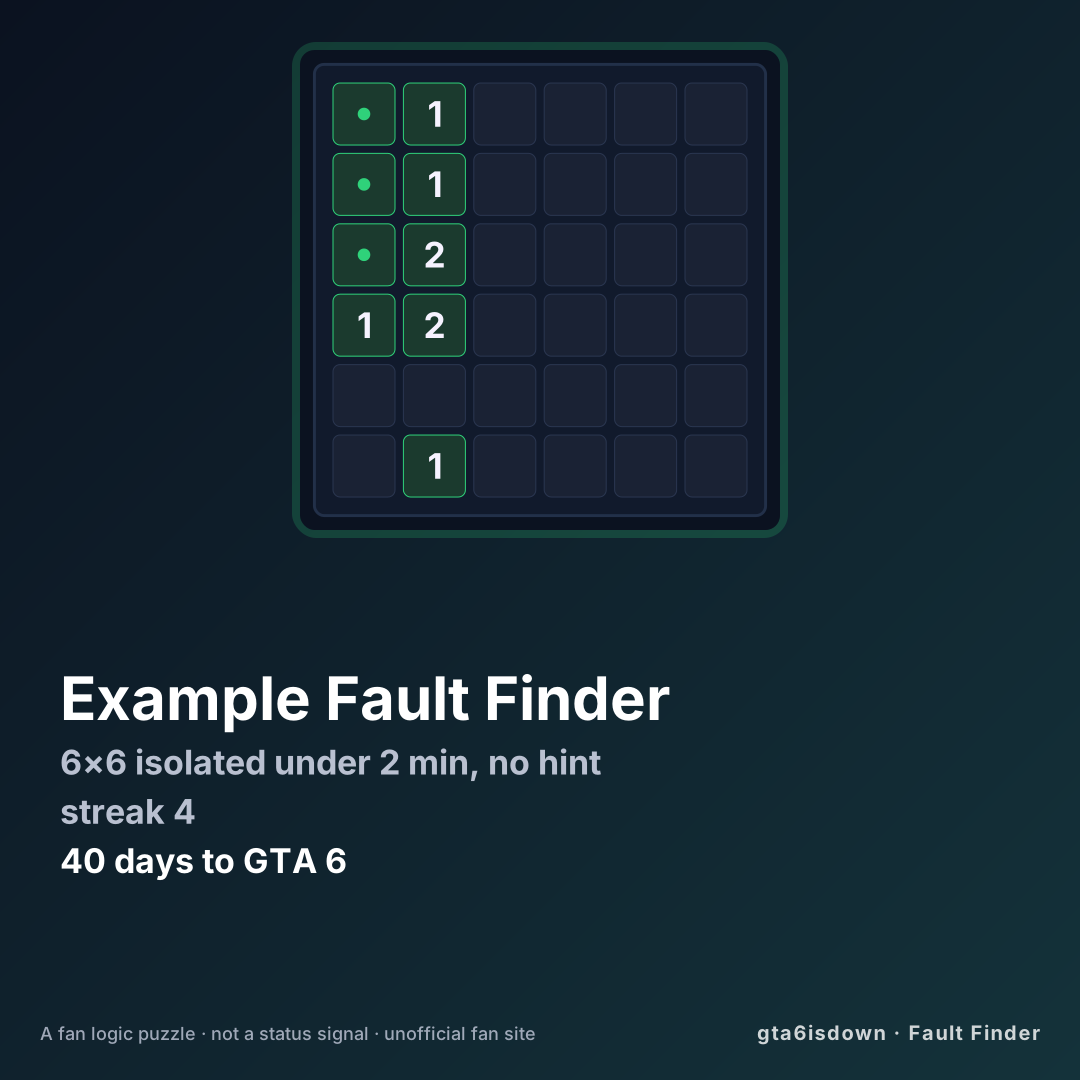
Today's card shows the cluster with its locked starters only, your time band, lives, streak and the days to launch; a card for an earlier day shows that day's cluster solved. Never today's faults.
Minesweeper-style on an imagined server cluster with three lives. 8×8 on weekdays, 10×10 at the weekend, a 6×6 warm-up, live rule checks, one hint, a streak, personal bests and a spoiler-free result to share. A fan puzzle, never a status signal.
How to play
The cluster is a grid of nodes, some faulty and hidden, and a few numbered nodes are cleared from the start. Clear every healthy node and flag every faulty one. A cleared node shows how many of its up to eight neighbours are faulty, and clearing a zero opens its neighbours too. Tap a node to clear it; long-press, right-click or F flags it. Clearing a faulty node costs one of three lives and the dig is taken back; a third hit fails the scan. A flag turns red beside a number that already has more flags than faults and a number turns red when every neighbour is decided and too few are flagged; the checks only ever look at what you have cleared, never at the answer. Undo and Clear are there when a corner goes wrong. Every cluster is checked when the site is built by a solver that applies the same deductions you do from the locked starters, clearing and flagging as it goes, and a cluster is kept only when those deductions finish it, so no cluster ever needs a guess and every one has exactly one answer.
Tip one: a 1 with one closed neighbour forces that flag, and a number with all its faults flagged clears the rest. Along the opened edge of the cluster most numbers sit beside one or two closed nodes; a 1 with a single closed neighbour marks it, and once a 1 has its flag every other node around it is healthy, which usually opens the next stretch. Tip two: the 1-2 pattern on an edge. A 1 beside a 2 in a straight line, both looking at the same closed row, share two nodes: the 2 needs one fault more than the 1, and the only place it can go is the node the 2 sees and the 1 does not. The 1-1 pattern works the same way with no extra fault: the node the second 1 sees alone is healthy.
Everyone gets the same cluster on the same UTC day: 8×8 on weekdays, 10×10 at the weekend, and newcomers can switch on the 6×6 warm-up, which still counts. One hint a day clears or flags one node the rules force, says which rule, and marks the result as assisted. When the last healthy node clears every remaining node is flagged, the cluster goes green, the faults are fenced off and the ops desk signs off with your time and lives. The archive lets you play any earlier day's cluster and practice clusters come from a spare pool; both are marked and never count. Fault Finder is a fan puzzle on an imagined cluster: nothing here reads any real service, nothing is a status signal, and nothing is presented as official. For more deduction try the Failover, the Rack Flip and the Signal Path.
Questions
What are the rules?
The cluster is a grid of nodes. Some are faulty (hidden); the rest are healthy, and a healthy node, once cleared, shows how many of its up to eight neighbours are faulty. Clear every healthy node and flag every faulty one. Clearing a zero opens its neighbours too. A few numbered nodes are cleared from the start as locked starters, so every cluster opens without a guess, and the named rules alone finish it.
What happens if I clear a faulty node?
You lose a life (three per day) and the dig is taken back, so the cluster keeps your progress. A third fault hit fails the scan: the cluster is revealed and the day records a failed result, which keeps the day played but breaks the streak.
How do I clear or flag?
Tap a closed node to clear it; long-press, right-click or press F to flag it as faulty (the same again takes the flag off); a tap on a flagged node also takes the flag off. On a keyboard the arrows move the cursor, Space or Enter clears, F flags, U undoes. Undo takes back the last change and Clear puts the cluster back to its starters. A red flag sits beside a number that already has more flags than faults; a red number has every neighbour decided and too few flags. The checks only ever look at what you have cleared, never at the answer. One hint a day clears or flags one node the rules force, says which rule, and marks the result as assisted.
What is the warm-up?
A 6×6 cluster for newcomers, switched on with the Warm-up toggle (remembered on this device). It counts as the day's solve; the 8×8 weekday and 10×10 weekend clusters are what the best times are about.
Is this the real status of anything?
No. Fault Finder is a fan logic puzzle on an imagined server cluster. Nothing here reads any real service, and nothing on the grid is a status signal. For the real launch-day picture, see the status page and the countdown on this site.


Keep exploring
Daily games: 29 pages to explore
- Load OrderA daily rack-ordering logic puzzle. Every row and column holds each load level once, and every arrow between racks…
- Prep priorityFour launch-prep steps a day, shuffled. Tap them in the order you would do them, from the weeks before pre-load to…
 How the status checks workWhere our GTA 6 status data comes from: official Rockstar, PlayStation, Xbox and Epic status sources checked every 5…