
Ping Hunt
One node on the board is silently failing.
Loading your friend’s challenge…
Ping Hunt
Today's board is on its way. Ping a node to start.
Ping a node: its reply tells you how far the failing node is.
Three stars at or under par, two within two of par, one for finding it.
Next board at midnight UTC.
How everyone did today appears here once 20 players have finished.
0Played
0%Win rate
0Streak
0Best streak
–Avg pings vs par
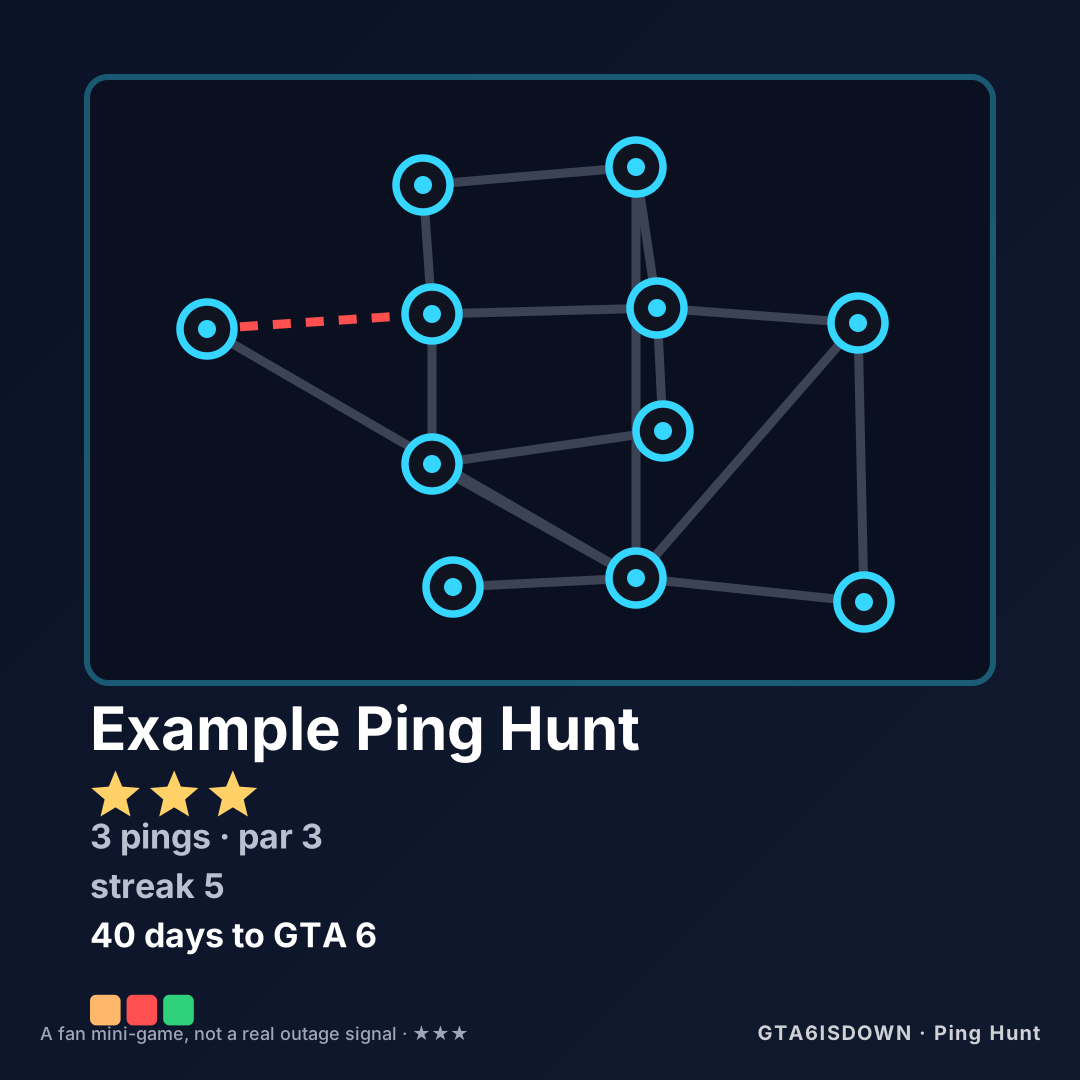
Your card shows the board's shape, your pings against par, your stars and streak and the days to launch, never which node was failing.
Ping nodes, read the latency hints, and find it in as few pings as you can. A new board every day at midnight UTC, harder through the week, with par, stars, a streak and an emoji grid to share. A fan mini-game, not a real outage signal.
How to play
The board is a small invented network: a dozen or so nodes with made-up names, joined by links. One of them has gone quiet. Pinging a node costs one ping and gives you two things: a latency figure and a band. Hot means the failing node is one link away, warm two, cool three and cold four or more. Found it is the node itself, which never replies. Distances are counted along the drawn links, not as the crow flies, so a node that sits next to another on screen can be several hops away if there is no link between them. The trick is to pick pings that split the board: a central node tells you more than one on the edge.
Par comes from a solver that plays the same board with that strategy, so it is a fair target rather than a lucky guess: three stars at or under par, two within two of it, one for finding the node at all. Every player gets the same board on the same UTC day, and the emoji grid you share shows your sequence of bands without giving the position away.
The week
- Monday: 7 nodes.
- Tuesday: 8 nodes.
- Wednesday: 9 nodes.
- Thursday: 10 nodes, one node lies once.
- Friday: 11 nodes, one link is cut (drawn dashed).
- Saturday: 12 nodes, one node lies once and one link is cut (drawn dashed).
- Sunday: 14 nodes, one node lies once and one link is cut (drawn dashed).
One node lies once: its first reply is two hops colder than the truth. Ping it again for the real answer. One link is cut (drawn dashed): packets cannot cross it, so hops count the long way round. Both twists are shown in the board's own words before you start, so nothing is a surprise.
None of this is a status signal. The nodes are fiction, the milliseconds are rolled from the day's seed, and no real service is being watched through the puzzle. For the real thing, use the live status and player reports; for a reflex version of hunting an outage, try Queue Dash or match real error codes in Error Code Match.
Questions
How do I play?
One node on the board is silently failing. Tap or click a node to ping it: the reply is a made-up latency and a band. Hot means the failing node is one hop away, warm two, cool three, cold four or more. Hops are counted along the drawn links. Use the replies to narrow it down and ping the failing node in as few pings as you can.
How are par and the stars worked out?
A solver plays the same board, always pinging the node that splits the remaining suspects best, and its ping count is par (one more on a day with a lying node). Three stars: at or under par. Two: within two of par. One: found it. Everyone gets the same board each UTC day, so pings against par are comparable.
What changes through the week?
Monday is a 7-node board and Sunday a 14-node one. From Thursday one node lies once: its first reply is two hops colder than the truth, so a second ping on the same node gives the real answer. From Friday one link is cut and drawn dashed: packets cannot cross it, so hops count the long way round. Saturday and Sunday have both twists.
Can I play with a keyboard?
Yes. Every node is a button: Tab to it and press Enter or Space to ping. Each reply is read out, and the ping log under the board lists every reply.
Is this about a real server?
No. The board, the node names and the latency figures are invented for the puzzle. Nothing here is measured or reported from any real service. For real signals use the live status page.
What are practice boards?
Random boards at any difficulty, as many as you like. They never count as the daily, never touch your streak or stats beyond a practice counter, and a practice board can be shared by its seed so a friend plays the same one.

Keep exploring
Daily games: 29 pages to explore
- Packet PipesThe link between the console and the server is scrambled. Turn the tiles until the signal reaches every one of them in…
- What's your hype level?How excited are you, really? Eight quick questions about trailers, the countdown and your launch-night plans score…
 PS5 and Xbox error codes: what they mean for GTA 6Error codes you might see while pre-loading, launching or playing GTA 6, explained using Sony's and Microsoft's own…